Goalsetting for beginners. Part 2 - Habits.
This is part two of “Goalsettings for beginners”, please read part I, if you haven’t already done so.
In this article we’re going to talk about habits. Now that you know what your goals are, we want to make this journey towards reaching them, as easy as possible, don’t we? And to accomplish this, we’re, among other things, going to replace the bad habits with good ones.
When you are starting a project (and that is exactly what this is), you need to somehow track how far you are going, and in which direction.
It’s like, when you are saving money to buy a particular item, and then once in a while, you go and check your savings balance, just to see how you are doing.
And before the process is even started, you take a look at your budget too see how much you can spare every month, right…?
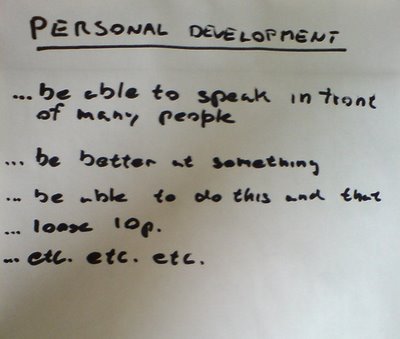
This is exactly what we are going to do here. For now we’ll concentrate on the “personal developing” goals.
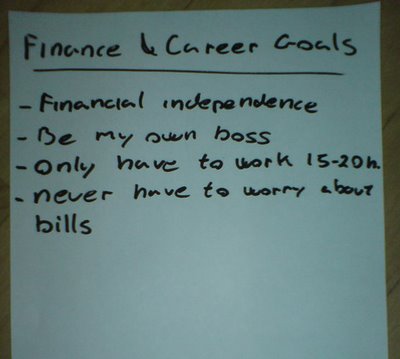
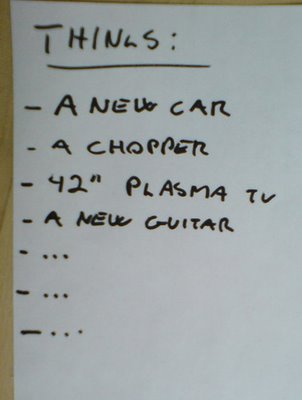
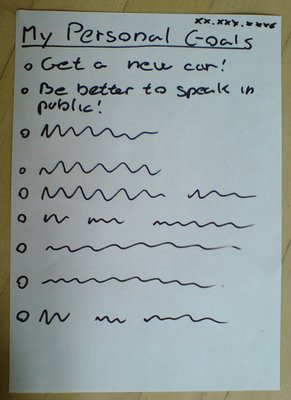
You know your goals now. Last time we defined your goals. And did without any limitations
You’ll have to be completely honest to your self now. Where do you stand in comparison to where you would be when you reach your goals?
Checkpoints.
(Just a quick note, I sadly left out in the former article.)
For now we’ll use a weight loss example. Let’s assume my first goal is to loose 20 pounds. Then it would be pretty easy to track my progress along the way, right? All I had too was to get up on the weight once every week and write down the result on a piece of paper. But how would I know if I were keeping up with the schedule?
What I need to do is to create some checkpoints along the way, let’s assume that it is possible to loose 2 pounds a week, without starving. Then off course there is no need to set the deadline of my goal a year from now. Let’s say 25 weeks, assuming that the last 5 pounds will go away a bit slower than the first 15.
Now I now, that my checkpoints is to loose 2 pounds every week, and if I do this, then I will reach my goal in 4 moths give or take a few days.
Well, surely it isn’t that simple with all goals.
If my goal were to be better at speaking in public, then it’s a bit harder to track and to evaluate my progress… well, that’s doesn’t mean it is impossible.
What I should do in that case is to create another type of tracking. Let’s say, that right now I am able to give a speech in front of two people, if there were three, then I’t would be almost impossible, to even say hello. Then let’s say my goal is to speak in front of 100 people within a year. Now I am able to define some checkpoints. One could be “in three months from now, I am able to give a five min. long speech in front of 10 people.”
As always it is important to get these things down on paper. I would recommend a journal, dedicated to personal development.
Environments.
You need to understand that your environment has a great deal to say when you are breaking habits. If I had a lot of junk food and several candies in my house, then it wouldn’t be very difficult for me, when I was vulnerable, having a bad day or whatever, to go absolute crazy, and eat everything I could find.
Therefore, what I would need to do now, is to replace all unhealthy food with healthy ones. Instead of chocolate and candy, go and buy lots fruit and low sugar candies.
Instead of frozen ready to cook fast-food, I could spend a day once a week, cooking, packing and freezing healthy ready to cook meals.
Instead of hanging out on McDonalds, I could join weight watchers. Got the point?
Alternative habits.
So back to the real deal.
Now we shall define you bad habits, and do something about them.
I want you to do this now. Take a piece of paper and write as the title your very first goal. Draw a line, dividing the paper in two. Write BAD / GOOD.
Below BAD, you must write any bad habits concerning this goal, you could imagine. Do a brainstorm. Foe example, if we stay with the example above, a bad habit could be “eating to much junk-food” or “always using the escalator, when one is available”.
Get going now.
Okay. Fantastic. Next step is to take each and every bad habit, and replace it with a good one.
On the top of my list is “too much junk food”, what could be done here. To find a suitable replacement, again I need complete honesty. To kill a weed, you need to tare it up by its roots.
I need to find the source of why I do eat too much junk food. It isn’t because it tastes good, cause it rarely does, at least not when compared to “real” food. So it must be because I find myself hungry at times, where I either have nothing else to cook, or simply because I am too lazy too cook, after a hard day of work.
A replacement candidate would be, “always have fruit at home” or “use one day a week to cook healthy fast food, and freeze it”.
Now do this: take each item on your list, and find an alternative. An alternative, there, besides help you quit the bad habit, also helps you get a step closer to your goal. Every day. Do this NOW.
Great. Now you have a list of every one of your bad habits, and what to replace it with. It should look like this: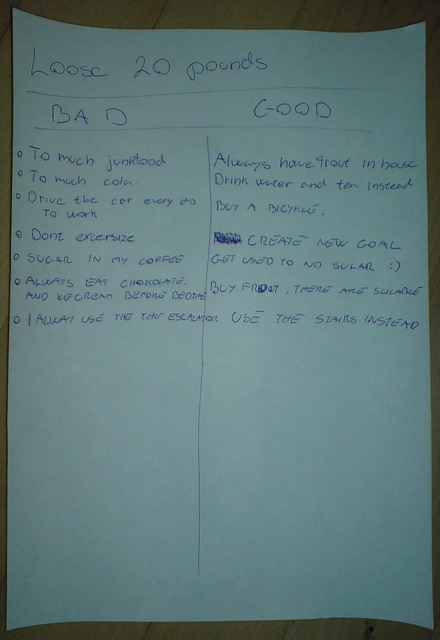
You’ll need to do this with all of your goals. Take time to do this today. Don’t procrastinate it. If you aren’t able to this right now, then do it tonight when the kids are sleeping or whatever keeps you from doing it now.
Off course it would be overwhelming to replace every one of your habits by sunrise tomorrow, therefore, what you need to do, is take one at the time. Maybe you are able to kill two each day, or perhaps you’ll need a week for each one of them. I have no way of knowing this, only you do, so take your time, but only as much as needed. Eliminate each and every one of them, starting right now.
Keep up with your progress.
You don’t need to hang these pieces of paper up everywhere in your house. Just keep them in a safe place. And make a commitment to yourself, right now, that you once a week, will keep track of your progress. A great way of doing this is to write a journal. Write one section about what you have accomplished in the last week, and what you have learned from you mistakes, and then write one section about what you are going to do next week. Sunday would be a good day to this I assume.
Motivation and willpower.
Here at the end, I will just leave a quick note about motivation.
When you are going to change your habits, the first period of time will always be difficult, at some point you’ll be tempted to go back to your old habits. In the very beginning your motivation will give you an abundance of willpower, but willpower is like adrenalin. It will only give you a boost, at some point it will run out, and then you’ll only have your motivation until it is reloaded again, so to speak.
This is why the whole thing about environmental changes is so very important. It helps you keep on track, to make it easier for you to move forward, rather than take one step back.
I really hope that this will get you a bit closer to reaching your goals, and if you have any comments, dont hesitate, leave a comment.
Until next time… enjoy your life, you’ll never experience anything longer than that. Have fun.